Recommendations from the Autorité de Régulation des Télécommunications (ART) for access to the local loop and its operational implementation / 30 October 2000
Annex 2: Order-delivery process
Services:
Order intention or feasibility studies (stage 1 of the process): for a given address, this service consists in France Télécom conducting a study of the transfer of existing pairs or of the construction of new pairs, indicating the time required to perform this work and the effective characteristics of the unbundled pair, and reserving the resources needed until the firm order.
Firm order (stage 2 of the process): this is an order to conduct unbundling with an express authorisation from the client. This stage may or may not be preceded by stage 1.
Receiving the pair (stage 3 of the process): on delivery, the operator checks the compliance of the pair with the estimated characteristics. A procedure for rejecting the pair will be defined.
Target process:
If France Télécom indicates to the operator that the pair has to be constructed by installing a new cable, a specific process is applied.
This process is as follows:
A service of supply of information is proposed independently of any order intention or firm order.
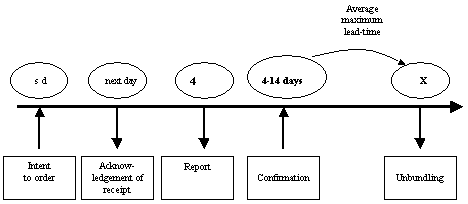
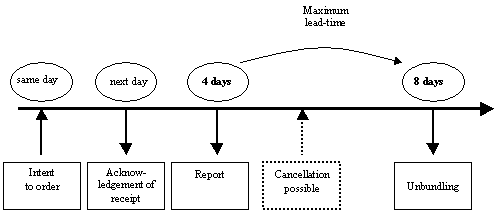
The operator expresses the intention to order a transfer or a creation and transfer at a given address (the operator may have previously requested information about the connection). France Télécom acknowledges receipt and responds within three (3) days with a report indicating whether the pair is eligible or whether a creation is possible, the earliest implementation date envisaged and the characteristics of the pair.
An order is considered firm if no cancellation has reached France Télécom within three (3) clear business days after the issuance of a positive report. The operator must have an express authorisation from the holder of the pair to be unbundled on the date on which the intent to order becomes a firm order.
France Télécom executes the order and sends a report to the operator indicating when the unbundling has been implemented.
The operator then receives the unbundled pair.
- Case 1: existing line
Transfer of pairs that already support telecommunications services
- Case 2: line in reserve
Creation of a pair from existing sections of the network.
The procedure is the same as for Case 1 with a timeframe of ten (10) days.
- Case 3: line to be constructed
Construction of a pair that requires the laying of a new cable or civil engineering work on the network.